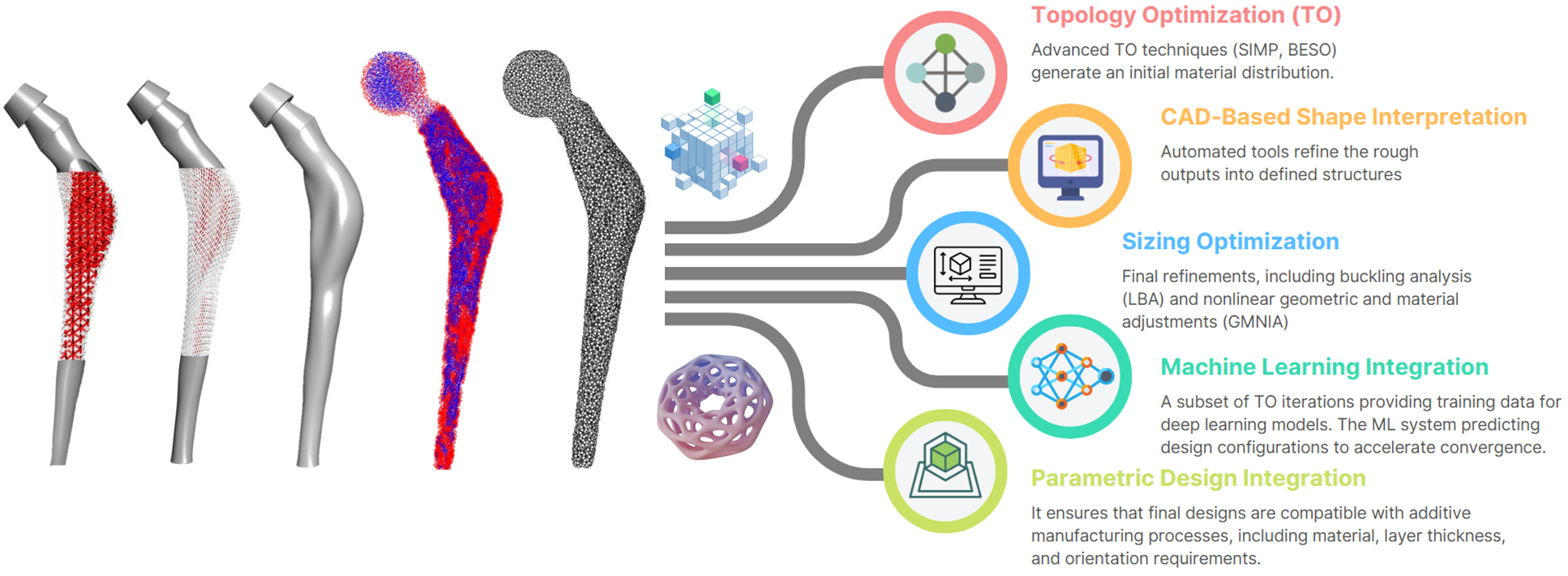
AI-driven design & optimisation
Develop AI-enhanced optimisation pipelines for patient-specific orthopaedic device design, leveraging simulation, topology/shape optimisation and data-driven models.
Sustainable orthopaedic solutions with AI-driven design and 3D printing for patient-specific CARE


Orthopaedic implants, scaffolds and braces increasingly require high levels of customization to match the patient’s anatomy and clinical pathway, while also meeting strict biomechanical performance and biocompatibility requirements. 3DCARE addresses this challenge with a closed-loop, data-driven framework that couples AI-enhanced design with advanced additive manufacturing and bioprinting to deliver patient-specific solutions with a smaller environmental footprint.
The project integrates optimisation, machine learning and simulation-based digital twins with material characterisation, manufacturing process planning and clinical feedback. Lifecycle thinking (including end-of-life strategies and circular-economy principles) is embedded from the earliest design stages to support sustainable healthcare manufacturing.
Through MSCA Staff Exchanges, 3DCARE builds an interdisciplinary network and training pipeline across engineering, computer science, biomaterials, and clinical orthopaedics, accelerating knowledge transfer and upskilling researchers for the next generation of personalised care technologies.
Develop AI-enhanced optimisation pipelines for patient-specific orthopaedic device design, leveraging simulation, topology/shape optimisation and data-driven models.
Create material datasets and characterisation workflows (mechanical, fatigue, bio-compatibility) to support robust digital design and manufacturing decisions.
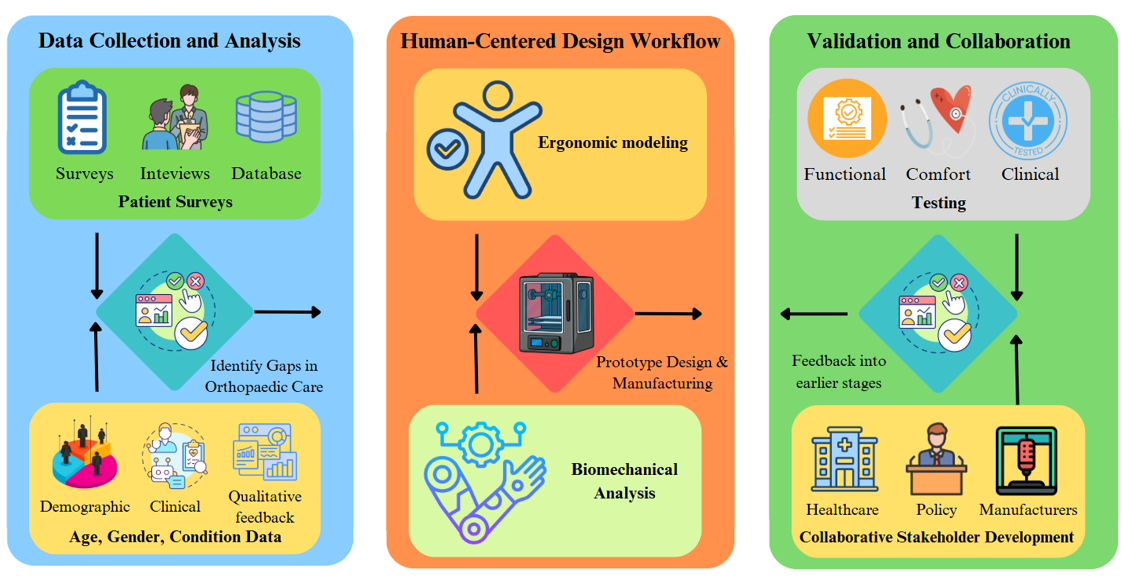
Systematically capture patient expectations and clinical requirements through focus groups and studies, including inclusivity and sex-difference considerations.
Integrate machine learning with additive manufacturing process planning and monitoring, enabling digital-twin-informed decision making across the design-to-production loop.
Develop and validate personalised bioprinted scaffold implants addressing bone loss and complex fracture reconstruction challenges.
Design and prototype 3D printed corrective orthoses for musculoskeletal deformations with clinical relevance and user-centric evaluation.
Maximise impact through open dissemination, higher-education learning tools, workshops, theses and targeted exploitation actions.
Ensure effective coordination, quality management and risk mitigation across the international staff-exchange network.
Lead: UOA-LAMSD | Months: M1–M28
Integrates advanced structural/device design concepts with material characterisation to underpin robust, sustainable patient-specific solutions.
Lead: MATHESI | Months: M1–M28
Elicits patient expectations and clinical requirements through focus groups and studies, addressing inclusivity and sex-difference aspects.
Lead: NTUA | Months: M6–M36
Develops the core optimisation and machine-learning framework supporting end-to-end additive manufacturing workflows and digital twins.
Lead: UOA-MED | Months: M19–M48
Bioprints personalised scaffold implants addressing bone loss, integrating design, biomaterials and validation needs.
Lead: ULEEDS | Months: M19–M48
Bioprints personalised scaffold implants for difficult reconstructions (interprosthetic fractures), advancing translational biofabrication.
Lead: MUP | Months: M19–M48
Designs and prototypes 3D printed patient-specific external corrective orthoses for musculoskeletal deformations and clinical pathways.
Lead: INFERSENCE | Months: M1–M48
Delivers dissemination and exploitation actions, including learning tools for higher education, workshops, theses, seminars and community building.
Lead: NTUA | Months: M1–M48
Project management, coordination, quality assurance and risk management across all partners and secondments.
3DCARE brings together complementary expertise across engineering, AI/ML, biomaterials, biofabrication and clinical orthopaedics, enabled through MSCA Staff Exchanges.
National Technical University of Athens (NTUA). Project coordination and management; AI-driven design and optimisation; lead WP3 & WP8.
Biomaterials and biofabrication expertise; lead WP5; contributes to patient-focused requirements and validation pathways.
Clinical and orthopaedic expertise; lead WP6; supports validation and clinical relevance of patient-specific orthoses.
Medical research and clinical translation; lead WP4 on personalised bioprinted scaffold implants for bone loss.
Laboratory of Advanced Materials, Structures and Digitalisation; lead WP1; materials/structures research and computational frameworks.
Industry partner; lead WP7; dissemination & exploitation, learning tools, workshops and community building; AI-driven tool development.
Lead WP2; patient focus groups, inclusivity and sex-difference aspects; supports multi-criteria optimisation activities.
Sustainability and lifecycle/environmental assessment contributions supporting cross-WP decision making.
Key outputs include software prototypes and optimisation workflows, validated manufacturing approaches, personalised (bio)printed demonstrators, and a strong dissemination programme (publications, events and educational material).
Planned exchanges: 21 secondment flows totalling ~360 person-months across the consortium.
| ID | Title | WP | Lead | Type | Dissemination | Due |
|---|---|---|---|---|---|---|
| D1.1 | Software Prototype for NTSDO | WP1 | NTUA | OTHER | SEN | M18 |
| D2.1 | Comprehensive Report on Patient Needs and Inclusivity in Orthopaedic Care | WP2 | ULEEDS | R | PU | M24 |
| D3.1 | Validated Optimization Framework | WP3 | INF | OTHER | SEN | M30 |
| D3.2 | Case Study Report and Prototypes | WP3 | UOA | R | SEN | M36 |
| D4.1 | Comprehensive Evaluation Report on Bioprinted Scaffold Implants | WP4 | ULEEDS | R | PU | M42 |
| D4.2 | Case Study Report and Prototypes | WP4 | MATHESI | R | PU | M40 |
| D5.1 | Patient-Specific Virtual Surgical Plan and Implant Design Package | WP5 | INS | R | PU | M46 |
| D6.1 | Report on Optimized Orthopaedic Devices | WP6 | UOA-MED | R | PU | M48 |
| D7.1 | 3DCARE Website | WP7 | UOA | R | PU | M2 |
| D7.2 | Plan for the dissemination and exploitation of results, including communication activities | WP7 | INF | OTHER | PU | M6 |
| D8.1 | Data management plan – Version 1 | WP8 | NTUA | DMP | SEN | M6 |
| D8.2 | Progress Report | WP8 | NTUA | R | SEN | M13 |
| D8.3 | Mid-term Meeting | WP8 | NTUA | R | SEN | M14 |
| D8.4 | Data management plan – Version 2 | WP8 | NTUA | DMP | SEN | M24 |
| Event | Location | Periodicity | Visitors | Scope |
|---|---|---|---|---|
| Orto Medical Care | Spain | Yearly | 10.000 | International |
| MEDICA | Germany | Yearly | 20.000 | International |
| 3D Print Congress & Exhibition | France | Yearly | 10.000 | International |
| Participation in conferences | Periodicity | Journals | Journals | Journals |
| World Orthopedics Conference | Annual | Journal of Orthopaedics | Journal of Orthopaedic Science | Journal of Orthopaedic Science |
| World Conference on Orthopedics, Sports Medicine and Rehabilitation (WCOSMR) | Annual | Operative Techniques in Orthopaedics | Annals of 3D Printed Medicine | Annals of 3D Printed Medicine |
| 3D Printing & Additive Manufacturing | Annual | Medical Engineering and Physics | Additive Manufacturing | Additive Manufacturing |
| International Conference on Orthopedics Arthroplasty and Rheumatology (ICOAR) | Annual | Progress in Additive Manufacturing | Orthopaedics & Traumatology: Surgery & Research | Orthopaedics & Traumatology: Surgery & Research |
| Interdisciplinary Conference on Orthopedic Value-Based Care | Annual | Rehabilitación | Rapid Prototyping Journal | Rapid Prototyping Journal |