
Data-driven material modelling
Derive a comprehensive library of data-driven constitutive laws for structural materials, supporting reliable analysis and design within AM-enabled workflows.
ADDitively Manufactured OPTimized Structures by means of Machine Learning (ADDOPTML) advances a new construction-ready paradigm that couples additive manufacturing with topology optimization, generative design and machine learning to enable rapidly tailored, resource-efficient civil structures.
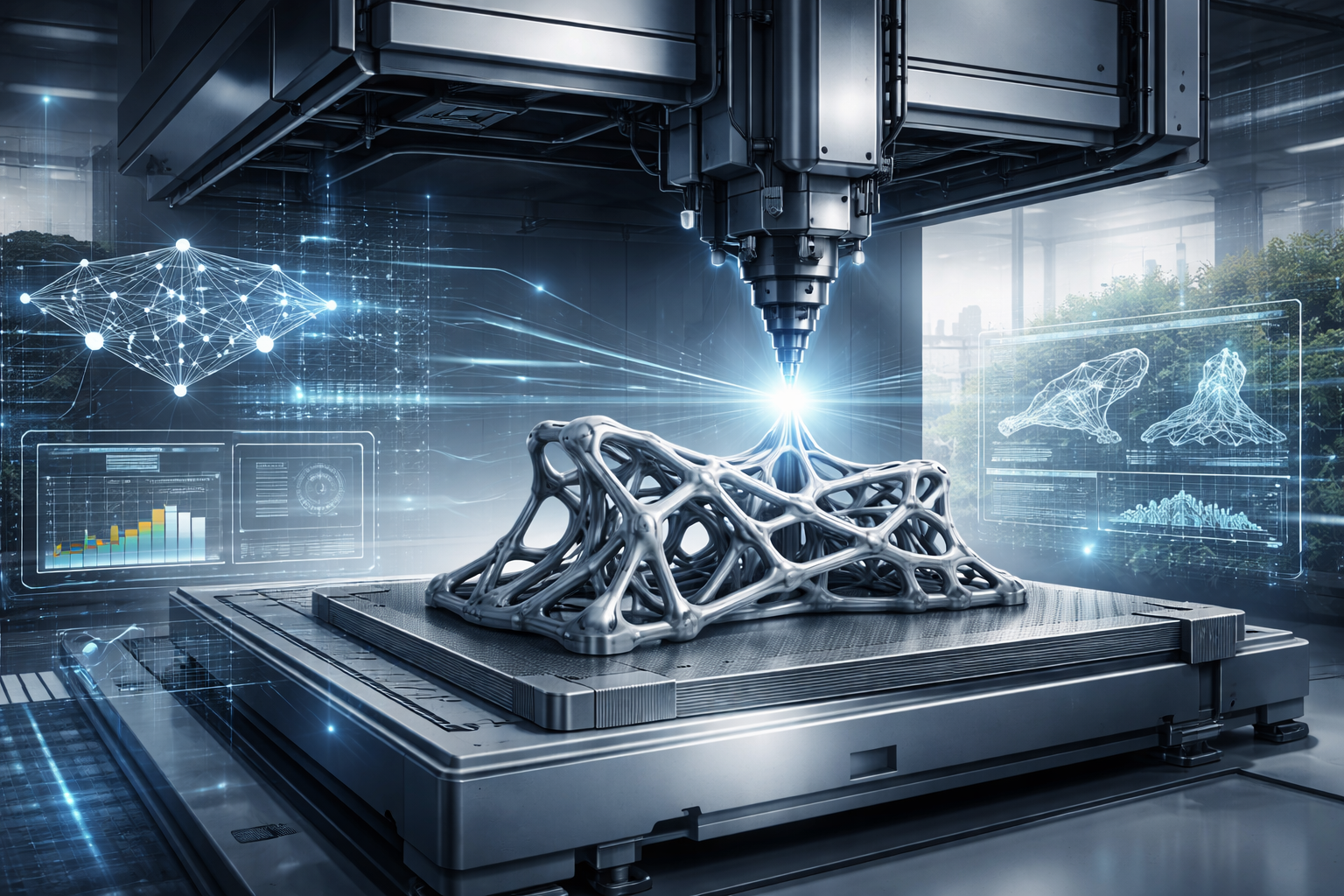
Additive manufacturing (AM) enables automated production of complex geometries and rapid conversion of digital models into physical objects, yet adoption in Architecture, Engineering & Construction remains limited due to fragmented design–analysis–construction workflows and the scale/uniqueness of civil structures.
ADDOPTML addresses this gap by developing and validating a holistic machine-learning-aided, optimization-driven design-to-manufacturing process for civil structures, leveraging progress in AM (including recycled consumables) and targeting reduced material use and construction waste—aligned with Europe’s climate-neutral ambitions.
As a primary application domain, the action targets rapidly deployable, resilient and adaptive structural solutions, including transitional and post-disaster structures.
Derive a comprehensive library of data-driven constitutive laws for structural materials, supporting reliable analysis and design within AM-enabled workflows.
Develop a high-fidelity yet rapid data-driven topology optimization environment for additively manufactured structural components.
Deliver a fully automated design workflow for AM structures based on the generative design paradigm, enabling rapid customization and scalable design exploration.
Apply the methods to rapidly deployable steel and concrete structures tailored for post-disaster sheltering solutions and other transitional applications.
Establish methods and protocols for an AM paradigm custom-fit to construction, addressing the sector’s non-automated, complex workflows around steel and concrete systems.
Strengthen knowledge exchange across academia and SMEs to bridge design, analysis, materials, fabrication and deployment.
Objectives and overarching aim adapted from the EC CORDIS project reporting description. :contentReference[oaicite:8]{index=8}
ADDOPTML is organized into focused Work Packages spanning optimization/ML methods, AM prototyping, demonstrators, and dissemination/training.
Develop topology–sizing optimization methodologies based on nonlinear FE analyses, assisted by machine learning.
Source: WP1 description. :contentReference[oaicite:9]{index=9}
Work on production/processing/classification of recycled metal powder and related material workflows that support AM for civil-structure components.
Source: WP2 tasks description. :contentReference[oaicite:10]{index=10}
Develop the ADDOPTML optimization and machine learning aided additive manufacturing framework, designed to act as a prototype generator (development–application–verification pipeline).
Source: WP3 description. :contentReference[oaicite:11]{index=11}
Investigate and develop physical prototyping methods based on additive manufacturing applicable to civil-structure elements and assemblies.
Source: WP4 description. :contentReference[oaicite:12]{index=12}
Detailed design, 3D printing and testing of scaled prototype deployable shelter solutions, including “3D-printing-ready” member and connection design.
Source: WP5 description + CORDIS deliverables. :contentReference[oaicite:13]{index=13}
Design/manufacture a structure combining energy-efficient design with renewable energy sources, insulation, and barrier systems (air/moisture), as a demonstrator direction.
Source: WP6 description. :contentReference[oaicite:14]{index=14}
Implement the proposed ML-aided AM framework and validate it through project use-cases, prototypes and structured verification activities.
Source: WP7 description. :contentReference[oaicite:15]{index=15}
Training, knowledge transfer and dissemination activities, including workshops, conferences and network-wide engagement.
Source: WP8 description. :contentReference[oaicite:16]{index=16}
VELTION contributes core expertise across: (i) optimization and ML-accelerated structural design, (ii) AM-ready member/connection design, (iii) demonstrator engineering and validation, and (iv) dissemination and training activities within the network.
Role aligned with network aim and demonstrator focus. :contentReference[oaicite:17]{index=17}
ADDOPTML builds synergies among academic and industry partners across Europe and beyond to connect materials, algorithms, fabrication and deployment.
National Technical University of Athens (NTUA) — coordination and core R&D in structural optimization, ML-enabled workflows, and demonstrator design. :contentReference[oaicite:18]{index=18}
Examples include Politecnico di Torino (POLITO) and Vrije Universiteit Brussel (VUB), among others, contributing to multi-disciplinary research spanning structural engineering, topology optimization, generative design and AM adoption. :contentReference[oaicite:19]{index=19}
The network includes a broad set of SMEs and technology organizations supporting AM, materials, welding, digital workflows and prototyping (e.g., IDEA75, IDONIAL, EWF, MX3D, INFERSENCE, JUST and others). :contentReference[oaicite:20]{index=20}
Politecnico di Torino (POLITO), University of Cyprus (UCY), University of Stuttgart (USTUTT), IDEA75, SPACEAPPS, IDONIAL, European Welding Federation (EWF), MX3D, Structures & Sensors, RISA, Vrije Universiteit Brussel (VUB), INFERSENCE, Jordan University of Science and Technology (JUST). :contentReference[oaicite:21]{index=21}